TouchDesigner in VDMX6 Plus
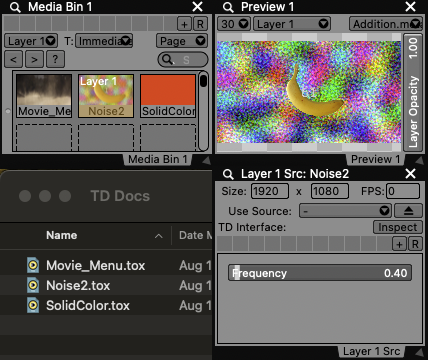
TouchDesigner is a node-based development environment, similar in many ways to Quartz Composer while at the same time having a lot of fundamental differences that make it a substantially unique environment with a vibrant user community that often overlaps with Quartz Composer. You can find more information here: https://derivative.ca or check out the VDMX TouchDesigner tutorial.
TouchDesigner shares many of the same benefits as Quartz Composer, and accordingly we have made it an integral part of VDMX, which has many different ways to work with TouchDesigner.
Example compositions
The VDMX6 Plus dmg Extras folder contains example compositions to help get started with making TouchDesigner compositions to use in VDMX.
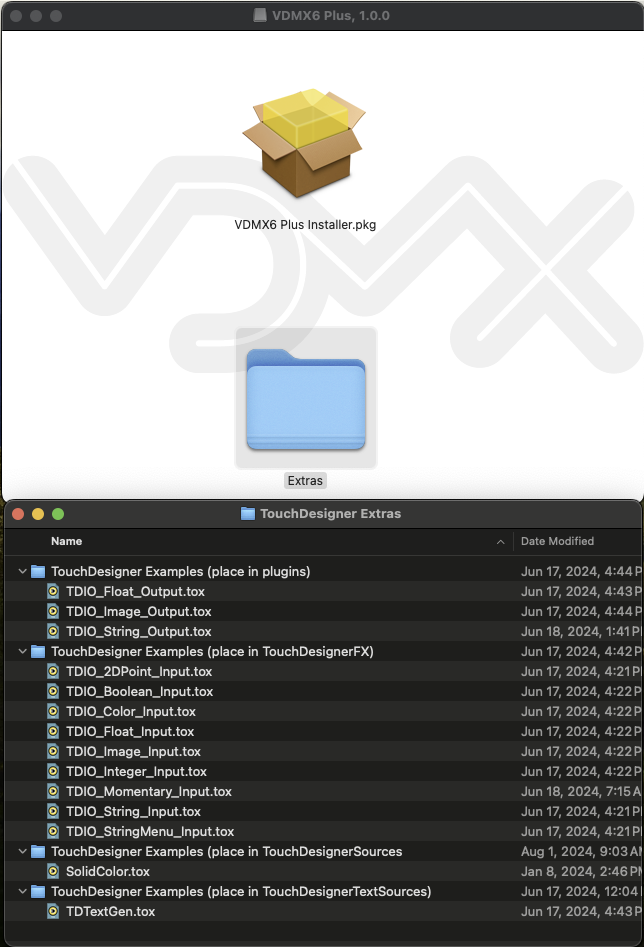
To install the demo files on your machine, go-to the VDMX assets folder located at: "~/Library/Application Support/VDMX/"
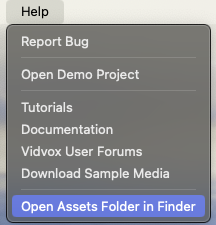
- You can use the “Open Assets Folder in Finder” option in the VDMX help menu to jump to this directory).
- You may have to create some of the folders yourself.
Use TouchDesigner sources in VDMX
TouchDesigner compositions require some minor modifications before they can be used in VDMX sources and effects, as demonstrated in the example compositions.
Once your compositions are ready to use in VDMX, the quickest way to get your TouchDesigner compositions doing something in VDMX is simply to drag them into a media bin (or choose "Import Media" from the file menu) and trigger them on a layer. There will be a delay of a few seconds the first time you trigger it while TouchDesigner compiles your patch, after which it will be played on your layer just like any other media file.
If your TouchDesigner composition has any published inputs, VDMX will automatically create UI items of the appropriate type (slider, button, color picker, text field, video source picker, etc) for them.
Passing control data and images from VDMX into patches using Published Inputs
TouchDesigner consists of objects which are connected together with patch cords. A complete description of how to use and work with TouchDesigner is beyond the scope of this wiki (TouchDesigner's documentation is excellent).
- Image-type inputs will be represented in VDMX as a pop-up button with a list of all available video sources (other layers, video inputs, syphon sources, etc).
- Real- and Integer-type inputs will be represented in VDMX as sliders. TouchDesigner lets you set a default min and max value (right-click on the published input and choose "Edit Details" to set this)- the slider in VDMX will have its range set by these values.
- Color-type inputs will be represented in VDMX as a standard RGBA/HSVA color picker.
- Boolean-type inputs will be represented in VDMX as toggle buttons (on/off).
- Point-type inputs will be represented in VDMX as a 2d point picker. The range of the values VDMX passes to TouchDesigner will be based on the dimensions at which the TouchDesigner composition is being rendered (VDMX passes pixel-scale coords to TouchDesigner, which at this time does not offer a way to specify the min/max values of its point-type inputs).
- Text-type inputs will be represented in VDMX as a text field.
- If you have a string-type input published with "FontMenu" anywhere in its name, VDMX will create a pop-up button with a list of all the system fonts (the name of the font will be passed to TouchDesigner when you select it).
- If you have a number-type input published with "VDMXBPM" anywhere in its name, VDMX will automatically pass the BPM of your clock to your composition. No UI item is created, this is handled entirely behind the scenes.
- If you have a number-type input published with "MeasurePosition" anywhere in its name, VDMX will automatically pass the measure position to this input as a value ranged 0.0-1.0.
Built-in TouchDesigner sources
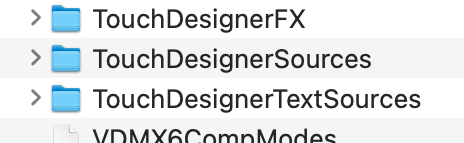
VDMX offers a number of built-in media files and video sources that are quickly accessible in the "Use Source:" pop-up button in the layer source UI. If you want your TouchDesigner composition to be listed here, place it in the "TouchDesignerSources" folder in your VDMX Assets folder (choose "Open Assets Folder in Finder" from VDMX's "Help" menu). It will immediately be listed as an available effect in VDMX, and can be previewed in the Workspace Inspector's "Assets" tab or added to layers.
Making Video FX with TouchDesigner
If your TouchDesigner composition conforms to the "Image Filter" protocol, it can be used as an image filter in VDMX- just place it in the "TouchDesignerFX" folder in your VDMX Assets folder (choose "Open Assets Folder in Finder" from VDMX's "Help" menu). It will immediately be added as an available effect in VDMX, and can be previewed in the Workspace Inspector's "Assets" tab or added to layers.
TouchDesigner-based VDMX Plugins
TouchDesigner compositions can be used as plugins in VDMX- when loaded as a plugin, VDMX will not only create UI items for any published inputs in your patch, but any outputs you publish will be made available in VDMX as either a video source (if the published output is an image-type splitter) or a data source (if it's a bool/number/color/string/etc). This allows you to use TouchDesigner to program complicated mathematical or logical behaviors that both receive data from and send data back to VDMX. Place these .tox files in the 'plugins' directory of the VDMX Assets Folder.
TouchDesigner Text Sources- Using TouchDesigner to Render Text
Text files in VDMX can be triggered and played back on layers- you can customize how your text files are rendered by creating TouchDesigner patches that will be used to render text. To be used as a text source, your TouchDesigner composition must have a string-type input published as "FileInput", and it must be placed in the "TouchDesignerTextSources" folder of your VDMX Assets folder (choose "Open Assets Folder in Finder" from VDMX's "Help" menu). Once you trigger a text file, you can choose which TouchDesigner compositions is used to render its contents using the appropriate pop-up button in the layer source controls- VDMX will automatically display a browser for your text file that allows you to trigger individual words/lines/etc (these words/lines/etc will be passed to your patch via the "FileInput").
Important notes
- Using TouchDesigner compositions in VDMX6 Plus requires a TouchDesigner install with a valid TouchDesigner license on the same computer (Education, Commercial, or Pro). Non-commercial will not work.
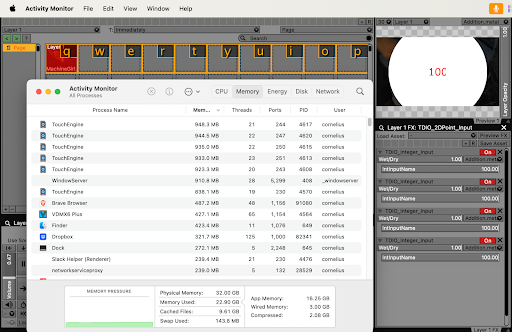
- Each time you launch a TouchDesigner file, it launches a new instance of the TouchEngine. Keep this in mind when opening up multiple TD files at once as it can pull a lot of memory.
TouchDesigner in VDMX6 Plus — Expanded Reference
This document picks up where the official VDMX TouchDesigner page leaves off: https://docs.vidvox.net/vdmx/vdmx_touchdesigner.html
The official page covers what each folder is for, the supported published-input types at a high level, and the licensing/memory caveats. This supplement covers the TouchDesigner-side construction details — the operator names, parameter styles, page conventions, and resolution wiring that a
.toxmust follow to behave correctly inside VDMX. Everything below is derived from the official Vidvox example.toxfiles shipped in the Extras folder of the VDMX6 Plus disk image.
1. Component contract
Every .tox exported for VDMX is a single top-level baseCOMP, exported via right-click → Save Component .tox…. Inside that component:
All published parameters live on a single custom page named
Custom(capital C, exactly).No
parentshortcutis set on the component. Vidvox examples reference parent parameters viaparent().par.Name, not via shortcut.A
parameterCHOPnamedpar1is conventional at the top level. It exports every parent custom parameter to a CHOP channel that other internal nodes can read. Configuration in every Vidvox example:Parameter Value ops..parameters*customTruebuiltinFalseIn Python:
parent.create(parameterCHOP, 'par1')followed by setting those four pars.
2. The Rendersize parameter
Every .tox — FX, source, text source, and plugin — must publish a Rendersize WH parameter on the Custom page. VDMX writes the host layer's pixel dimensions into this parameter every frame.
| Setting | Value |
|---|---|
| Style | WH (width/height pair) |
| Parameter name | Rendersize (creates Rendersizew / Rendersizeh internally) |
| Label | renderSize (camelCase, exactly) |
| Default | 1920 × 1080 |
In Python:
page = comp.appendCustomPage('Custom')
rs = page.appendWH('Rendersize', label='renderSize')
rs[0].default = 1920; rs[0].val = 1920
rs[1].default = 1080; rs[1].val = 1080
Driving internal resolution from Rendersize
Your render chain has to actually use Rendersize, otherwise VDMX will receive a fixed-size image regardless of the layer it's been dropped on. The standard pattern:
- Set the source
renderTOP'soutputresolutiontocustom. - Bind
resolutionw/resolutionhtoparent().par.Rendersizew/parent().par.Rendersizehas expressions.
render.par.outputresolution = 'custom'
render.par.resolutionw.expr = 'parent().par.Rendersizew'
render.par.resolutionw.mode = ParMode.EXPRESSION
render.par.resolutionh.expr = 'parent().par.Rendersizeh'
render.par.resolutionh.mode = ParMode.EXPRESSION
The fitTOP safety net
Some palette COMPs and feedback loops have internal resolutions that can't be re-routed from the parent. Insert a final fitTOP between the last node of your network and outputImage, with its resolution bound to Rendersize. This guarantees the output that reaches VDMX is always exactly the requested size, regardless of what's happening upstream.
fit = comp.create(fitTOP, 'resize')
fit.par.outputresolution = 'custom'
fit.par.fit = 'fill'
fit.par.resolutionw.expr = 'parent().par.Rendersizew'
fit.par.resolutionw.mode = ParMode.EXPRESSION
fit.par.resolutionh.expr = 'parent().par.Rendersizeh'
fit.par.resolutionh.mode = ParMode.EXPRESSION
Note: an
outTOPdoes not resize its input — its Common-pageoutputresolution/resolutionw/resolutionhparameters evaluate but do not actually rescale. The resampling has to happen on a node beforeoutputImage.fitTOPis the cleanest choice.
3. Required operators by folder
VDMX recognizes input slots and output streams by the names of top-level operators inside the baseCOMP. The contract differs per folder:
TouchDesignerFX/
| Operator | Type | Required | Notes |
|---|---|---|---|
inputImage | inTOP | Yes | Always present, even when not actively used. Receives the layer below. |
outputImage | outTOP | Yes | The processed result returned to VDMX. |
Additional inTOPs | inTOP | Optional | Each extra top-level inTOP becomes another Video Input slot in VDMX, named after the operator. The Vidvox TDIO_Image_Input.tox example ships an extra inTOP named dodgeImage that VDMX exposes as a second input. |
TouchDesignerSources/
| Operator | Type | Required | Notes |
|---|---|---|---|
outputImage | outTOP | Yes | The generated output. |
inputImage | inTOP | No — sources have no input. | Do not include one. |
TouchDesignerTextSources/
| Operator | Type | Required | Notes |
|---|---|---|---|
outputImage | outTOP | Yes | The rendered text frame. |
FileInput parameter | Str | Yes | A published string parameter labeled exactly FileInput. VDMX writes the active text-source identifier into this parameter. |
fileOutputNext | outCHOP | Optional | Pulse on this channel signals VDMX to advance to the next text item. |
fileOutputPrev | outCHOP | Optional | Pulse on this channel signals VDMX to rewind. |
plugins/
Plugins can output any combination of operator types — they're not restricted to images. The operator's name becomes the source's name in VDMX's Data Sources list.
| Operator type | Use | Example name in Vidvox tox |
|---|---|---|
outTOP (any number) | Image streams | outputImage, secondOutputImage |
outCHOP (any number) | Float / numeric streams (first channel) | floatOut |
outDAT (any number) | Text streams | textOut1 |
A plugin can publish, e.g., one outCHOP only — no image required. See TDIO_Float_Output.tox (one outCHOP named floatOut, driven by an lfoCHOP) and TDIO_String_Output.tox (one outDAT named textOut1, driven by evaluateDAT → convertDAT).
4. Published parameter reference
Drop all user-facing parameters on the Custom page. The label, not the parameter name, is what VDMX displays. Use CamelCase labels (e.g. BaseColor, LightIntensity).
| VDMX UI control | TD style | Python | Notes |
|---|---|---|---|
| Float Slider | Float | page.appendFloat('Name', label='Name') | min/max/normMin/normMax define slider range |
| Integer Slider | Int | page.appendInt('Name') | |
| Toggle Button | Toggle | page.appendToggle('Name') | Boolean |
| Momentary Button | Pulse | page.appendPulse('Name') | Trigger / fire |
| Text Field | Str | page.appendStr('Name') | Plain string |
| Pop-up Menu | StrMenu | page.appendMenu('Name', menuNames=[...], menuLabels=[...]) | Defined in TD |
| 2D Point Pad | XY (style reads XYZW) | page.appendXY('Name') | Two-component pair |
| Color Picker (RGB) | RGB | page.appendRGB('Name') | 3 channels |
| Color Picker (RGBA) | RGBA | page.appendRGBA('Name') | 4 channels — VDMX uses RGBA / HSVA picker |
| Render Size | WH | page.appendWH('Rendersize', label='renderSize') | The one and only Rendersize parameter — see §2 |
| Video Input slot | n/a — inTOP | comp.create(inTOP, 'name') | Top-level inTOP; the operator name becomes the slot name in VDMX |
Group styles that VDMX does not expose
These styles produce parameters that VDMX skips entirely — even though they appear in TouchDesigner:
| Style | Workaround |
|---|---|
XYZ (3-component point) | Use three individual Float parameters named Namex, Namey, Namez. |
XYZW (4-component) | Use four individual Float parameters. |
File (file-picker) | Use Str style instead. VDMX shows a text field; users paste the file path. |
If your source/effect needs to load a model, video, or texture file, the Str workaround also makes the path editable directly inside VDMX without re-saving the .tox.
5. Reserved label names
The official documentation lists these — included here for completeness with the TouchDesigner-side specifics:
| Label (exact) | Style | Effect |
|---|---|---|
renderSize | WH | VDMX writes the layer's pixel size into the parameter every frame |
FileInput | Str | Marks a Text Source parameter as the active file/identifier (text-sources only) |
FontMenu | StrMenu | Replaces the menu values with the system's installed fonts |
VDMXBPM | Float | VDMX passes the current host BPM; no slider is shown in VDMX |
MeasurePosition | Float | VDMX passes a 0.0–1.0 position within the current measure; no slider is shown |
6. Recommended top-level layout
A minimal, convention-aligned skeleton (any of the four folder types — strip the parts that don't apply):
/myFX (baseCOMP — the file you save as .tox)
│
├── Custom page
│   ├── Rendersize     (WH, label "renderSize")
│   └── …your published parameters
│
├── par1               (parameterCHOP   — exports parent custom pars to channels)
├── inputImage         (inTOP           — only for TouchDesignerFX)
├── outputImage        (outTOP          — for FX, Sources, TextSources, Image plugins)
├── …your network…
└── resize             (fitTOP at the end → outputImage, driven by Rendersize)
For plugins, replace outputImage with the appropriate outTOP/outCHOP/outDAT(s), each named to suit the data they expose.
7. Common pitfalls
| Symptom | Cause | Fix |
|---|---|---|
| Sliders work but VDMX shows a black or transparent output | Internal renderTOP not bound to Rendersize; render chain renders at a fixed size while VDMX expects a different one | Bind renderTOP.resolutionw/h to parent().par.Rendersizew/h, set outputresolution=custom |
| Output appears upscaled or letterboxed in VDMX | Final node has fixed resolution that doesn't match VDMX's request | Insert a fitTOP driven by Rendersize between the last node and outputImage |
A parameter is missing in VDMX even though it's on the Custom page | Parameter style isn't supported (XYZ group, File picker, etc.) | Convert to individual Floats or to a Str |
Modelfile / MoviePath parameter doesn't update internally when changed in VDMX | The internal op references a different parameter, or path is cached | Bind the internal op's file parameter to parent().par.<YourPar>.eval() as an Expression |
| Effect renders fine in TD, blank in VDMX | A palette COMP inside has a feedback loop pinned at a fixed resolution | Add the fitTOP safety net (§2) |
| Sliders appear but the host TouchEngine never finishes loading | Non-Commercial TouchDesigner license | Install Education / Commercial / Pro |
8. Notes on iteration
Changes to a .tox are not live in VDMX. To iterate:
- Edit the composition in TouchDesigner.
- Right-click the top-level
baseCOMP→ Save Component .tox… - Overwrite the file in the matching VDMX assets folder.
- In VDMX, remove and re-add the asset (or restart the host).
Parameter values exposed to VDMX are live within a session — the user can drive them from VDMX's UI, MIDI, OSC, or the cuelist without re-saving the .tox. Only changes to the network structure (new ops, rewiring, new pars) require re-export.